More useable Key Coloring + missing Advanced Key Matches

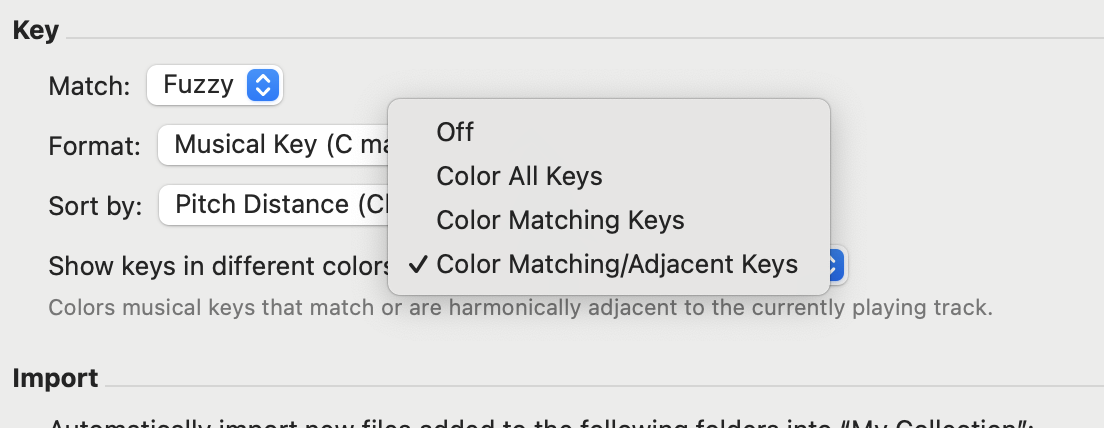
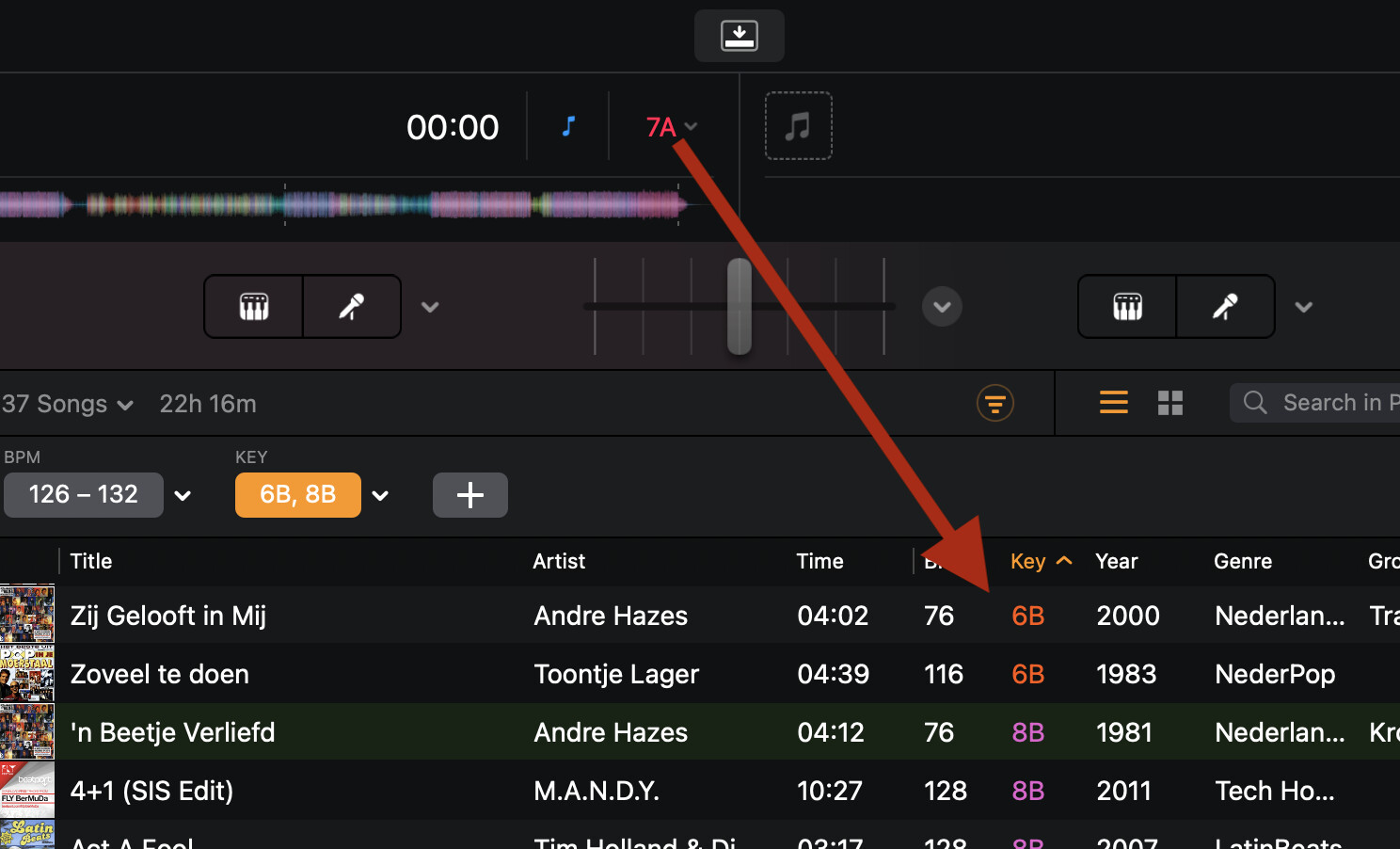
Thanks for the much awaited new feature "Added support for coloring keys or similar keys in media library (in media library settings) " in Djay 5.6 that only shows harmonically compatible keys in color. It already reduces visual clutter and makes choosing the next track much easier.

However did I find two important points that could make the feature much stronger:

Colors or icons for transition types
The current colors don’t convey much information. It would be much more valuable if colors (or, even better) clear icons indicated the type of transition, such as energy up, energy down, mood shift, diagonal mix, or jaws mix. This gives immediate insight while mixing, beyond just the key color.

Missing 6 possible harmonic matches
I noticed that six possible harmonic or energy options don’t get a color, even though they are valid transitions and the setting is already on “Color Matching – Adjacent Keys.” Examples:

  • Jaws Mix (+1 semitone, e.g., C to C#)
  • Switching Scale Mix (e.g., F to Fm or Fm to F)

These are not currently recognized as matches, although many DJs use them regularly. (As a matter of fact.This flaw was already present in the previous versions of djay’s Match function.)

I hope you’ll consider these improvements. They would make “Color Matching – Adjacent Keys” more powerful and better aligned with how DJs use harmonic mixing in practice.
2 Likes

I see the value of this too, but you should be able to only switch on types you’re interested in.

As an extension of this a ‘flexible’ filter for only showing compatible tracks would make my life even easier (as opposed to hard-coding and updating the key in the filter).

1 Like

I completely agree with this proposal. You have my vote.

While the new coloring feature is a great step forward to reduce visual clutter, missing out on the ‘Energy Boost’ (Jaws Mix / +1 semitone) feels like a gap. Many of us use that specific technique to build hype in the set, and having it visually recognized (instead of greyed out) would be a game changer.

Also, the idea of using icons or specific indicators to know the type of transition (energy up/down) at a glance is brilliant.

1 Like

You’re welcome @DJ_Big_Blender. Thanks again for the additional input - I’ve passed this onto the devs for review and consideration.

You are Correct @Mister_Tuur. That would be the best. Being able te select/deselect different types of harmonic transitions would be awesome, but being aware that this simple addition already took ages I think asking for the ultimum would probarly be a step too far.

1 Like

Hi @Slak_Jaw,

As the new Key-Match-Coloring option in 5.6. was a very well welcomed and adapted feature I think it’s very important for the user-community to know what the response of the devs was about the missing matches that I reported..

Could you share this with us?

Can we expect to see the missing matching combinations here as well soon, or do they embrace some more traditional musical rule this ignores these extra matches?

Maybe adding another additional setting on this spot could help us all out here?

Hi again @DJ_Big_Blender, thanks for checking in. The team is looking into this, but we don’t have any news to share at this time. When that changes, I will share news in the community. Thanks!

You’re absolutely right @Albert_Maro !

Personally, I try to avoid mixing down in energy (that is a −5 semitone move, like C to F). The issue right now is that, as it’s implemented, you can’t quickly distinguish energy-down matches from other harmonic options.

If different types of combinations could be disabled or -even better- visually identified, it would be much easier to make deliberate choices during a set, instead of treating all matches as equal.

1 Like

Thanks for the additional input @DJ_Big_Blender

Hi @DJ_Big_Blender, @Mister_Tuur and @Albert_Maro, I discussed this with our engineering team in detail

The “matches” you mention aren’t really matching in the sense we highlight right now (i.e. tracks that probably sound fine when mixed together), but rather advanced harmonic mixing techniques that involve transitioning to a key that is intentionally dissonant to create a certain kind of contrast/effect. We’re not entirely opposed to highlighting these, but different people online have identified several of these. The total we could find where:

  1. ±2 steps (whole step up/down)
  2. ±3 steps (major/minor of same root)
  3. +7 steps (semitone up)
  4. +6 steps (“opposite”, tritone away)

Conclusions:

  • These are not “go ahead you can mix these” - no brainer matches.
  • If we highlight them, it needs to be entirely visually distinct (just using a different color would break the original feature for color blind users).
  • You gave your two favorite ones, but others are probably using other techniques and we’d consider this a slippery slope towards highlighting half of the camelot wheel.
  • It seems that these advanced harmonic mixes might be better handled manually by advanced users who fully understand their use cases.
  • Please review and let us know what you think. Thanks!
1 Like

I totally agree with these conclusions.

1 Like

Thanks for the feedback @Mister_Tuur

Hey @Slak_Jaw

Thanks for taking the time to discuss this internally and for the clear explanation.

Before going deeper, I’d like to clarify a few things so we’re talking about the same concepts:

First, when you refer to “steps”, are these steps on the Camelot wheel or steps in musical keys (semitones)?

Second, can you confirm that the current Match functionality in djay only suggests tracks in the same key plus up to three other distinct keys? (With C in the active deck it comes with C and F,G & Am tracks)
This is different from the new “show keys in different colors” option in playlists, which can display up to five different keys alongside the same-key tracks. (With C it comes with F, G & Am .. but also with Dm and Em).

Last, and important for alignment: does the team acknowledge and respect the harmonic mixing theory used by Mixed In Key as the industry-leading key detection tool? And if so, is there an intention to broadly follow their guidelines, or is Algoriddim consciously choosing a different theoretical approach here?

Looking forward to your thoughts.

The key point is that many so-called energy boost techniques are not based on full harmonic compatibility / “classic” harmonic mixing theory, but on intentional semi-harmonic or non-harmonic transitions.

These transitions require more awareness, timing, and control from the DJ. When executed deliberately, they can sound great and feel exciting. But they are not as universally safe or predictable as their classic counterparts, which is why it makes sense that DJ software doesn’t automatically flag them as harmonic matches (one could even say that technically, they are not a ‘match’).

They are valid techniques, but they rely more on musical judgment than harmonic rules, so it is a different category IMO.

1 Like

Exactly! Thanks for sharing @Mister_Tuur

@DJ_Big_Blender

  1. The steps on the list provided above are steps on the Circle of Fifths / Camelot wheel. Semitones/musical intervals were given in parentheses.
  2. Match logic depends on the source, but for local tracks we can confirm that match prefers the three most similar keys (i.e. for 7A that is 7B, 6A, 8A).
  3. Our understanding is shaped by classical music theory, our own research, and publicly available resources on harmonic mixing. We consider Mixed in Key to be one of those resources, however we strive to keep djay open to different techniques and approaches.

I hope that helps!

This got me thinking. And it’s going to be a little off topic, but still a solution.

One thing that’s missing from the playlist filter system is not just flexibility, but logical structure. Right now, filters mainly act as hard constraints resulting in having to setup a lot of variations.

This could be solved when you introduce relative / dynamic filters based on the currently active track.

Imagine a rule system that explicitly supports [AND] and [OR] logic, where rules can either filter or annotate.

For example:

Result-defining rules (hard filters):

  • [AND] (BPM ±5)

  • [AND] (year ±5)

These rules narrow down the list and define what is even worth considering.

Contextual / complementary rules (non-exclusive):

  • [OR] (key ±1) → color green + text #safe

  • [OR] (key ±2) → color yellow + text #boost

  • [OR] (genre [is same]) → text 🟢 (emoji)

In this model:

  • [AND] rules restrict the result set

  • [OR] rules can coexist and layer meaning onto the same track

  • A track can match multiple contextual rules without being excluded

  • The first matching color rule determines the row color, while additional matches can add tags or emojis

  • Ideally the color could be linked to either a row and / or a column

This allows harmonic compatibility, energy moves, and stylistic similarities to live side by side, instead of being forced into a single “match / no match” decision.

If this were paired with a dedicated column for dynamic / filter defined text (e.g. tags or emojis), you could even use the already existing filter within the results — enabling drill-down workflows like:

  • Show safe harmonic matches → filter on #safe

  • Show higher-energy options → filter on #boost

  • etc

All changing dynamically depending on the current track. Rather than endlessly expanding the number of filters or “harmonic match” options, this kind of logical, layered filter system would make djay’s playlists both smarter and more close to how DJs actually think and work.

The drill-down would also solve the “sorting issue”. Instead of sorting on only one column (or even multiple) and having to scroll through your list again you could simply narrow the results on the fly.

All this could probably also be implemented as a smart dynamic (playing track aware) playlist.

My 2 cents.

2 Likes

Hey @Slak_Jaw,

Thanks for the quick reply. Below you find my response.

  1. As you mix up things (like semitones/steps) your example is still unclear to me. E.g. +3 steps in camelot is not Minor/Major of same root. Also djay software itself doesn’t follow these rules. E.g. +7 steps (semitone up) is not shown. And what happened to just one step up or down in the wheel. This is the most used and compatible step in the Camelot wheel that you don’t mention.

  2. Yes but when you look into the colored keys in the playlist, djay does also “give” 6B (=Bd) and 8B (=C) as an option for 7a (=D minor). Talking about experimental. I cannot think of any reason why the Match option differs from the colored options in a playlist, so I believe this needs refining.

  3. Great to hear that you are open to different “techniques”, but I think MiK did already ‘invent the wheel’ here that Top DJ’s in the world use and follow. I don’t think djay can add more knowledge or experience at this point. if Djay simply followed the Mixed In Key match and energy-boost options, that alone would be already much more valuable, but unfortunately at this moment users are shown limited of options and even being confronted with incompatible options.

(Here is a very well-documented video with examples of all transition options and whether they are considered ‘safe’ or not: https://www.youtube.com/watch?v=xe6gZS_D0JM)

*This video even proves that options Djay considers ‘safe’ are not always safe, and vice versa, so that argument is not valid.

1 Like

Just so we’re clear, they didn’t actually “invent” it, but they definitely helped it become super popular! :grinning_face_with_smiling_eyes:

2 Likes

At the end of the day, no DJ mix is ever truly safe until you have tried it to see if it sounds right.. a perfectly key matched mix can sound much worse than a non key matched mix due to other factors. As @Mister_Tuur pointed out, there becomes a point where the DJ themselves has to take control and be the ultimate decision in what is going to work and what isn’t.

There’s also other things to factor in, one being that on average 1 in every 4 tracks that is analysed is analysed incorrectly, and even then a producer might not be keeping the elements of their track key matched when they produce it, tracks can either have different non matched elements being used at the same time, or shifts in key between different parts of the track.

If you’re that heaviliy invested in the whole concept of key matching, then you have to be the driver of that decision making, otherwise treat it as a useful tool that may or may not help you pick the right music to mix in next, with your own ears being the deciding factor above all else.

2 Likes